

Wedding Traditions Series
The following article was commissioned by Pointe Foure, a vintage clothing boutique in Erie PA, during my recent internship. This is article three in a series of three.
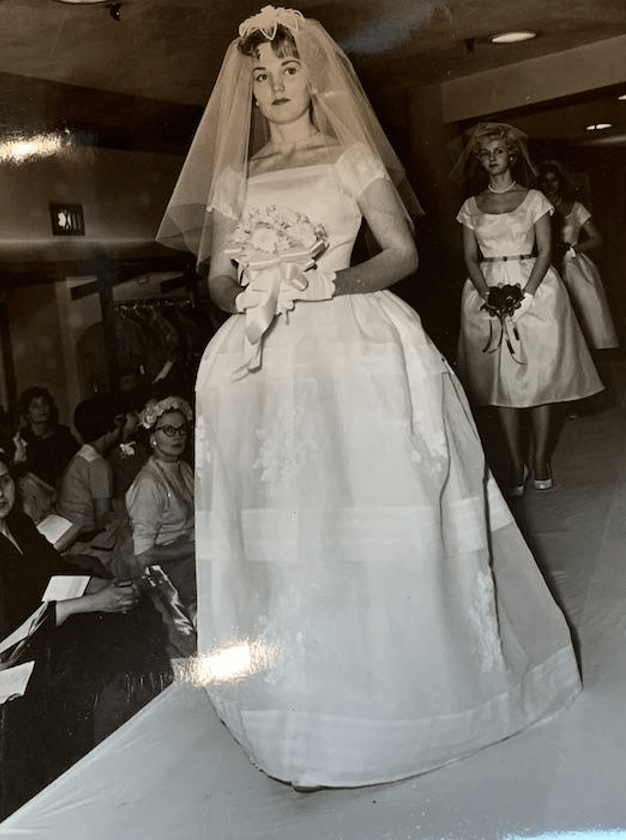
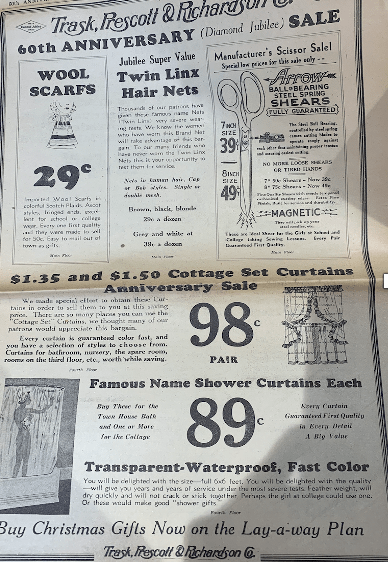
A wedding is perhaps one of the most significant milestone moments in a person’s life, and for the bride, choosing just the right gown for the occasion is a special event in itself. One local Erie store earned a loyal following for nearly a century, with its premiere bridal boutique located on the third floor of the familiar Trask’s Department Store. Each Spring, the newly engaged anticipated the announcement of “Bride’s Week,” an annual Trask event that catered to the unique needs of brides to be.
Trask’s Opened in 1877 on Ninth and State St. in downtown Erie. It was well known for clothing and everyday items for the house. In 1937, the local Erie newspaper featured Trask’s ads referring to its 60th anniversary as a Diamond Jubilee with year-long sales events. For local Erie families, Trask’s was a familiar and popular showroom.
Each year, after the busy Christmas season, the staff and management at Trask’s, began a full-force effort to prepare for their signature “Spring Bride’s Week.” Planning involved nearly every department. Meeting notes acquired from the Hagan History Center’s expansive archives shows a number of duties assigned to each department before the annual event.
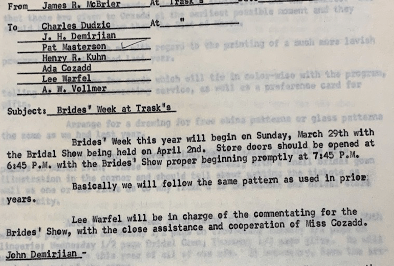
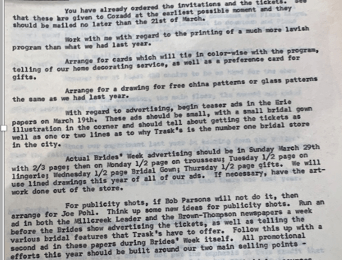
Mr. Masterson, from the advertising department, was directed to order invitations, print tickets, and design a series of ads for the local newspaper. Mr. Dudzic coordinated the store window displays, which would feature bridal gowns. Early in the year, a theme was chosen, such as 1959’s “Once in a Life Time” and 1967’s “Love’s Young Dream.” Every detail, including catering, microphones, music, and parking, were discussed weekly at staff meetings leading up to event day.

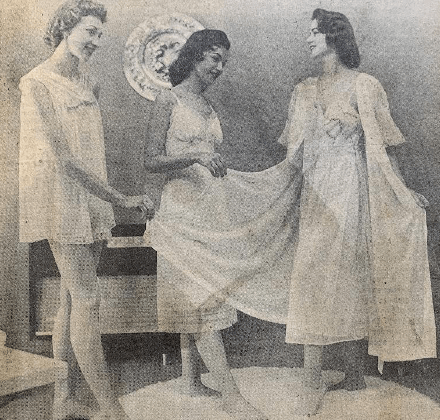
Young brides, their mothers, and bridal parties anxiously awaited the announcement for “Bride Week” registration. The event was free but required a ticket, which could be obtained directly from the bridal salon. The catered reception included a showing of china, crystal, and silver, along with lingerie, stationery, and bridal gifts. The highlight of the evening was, of course, the elegant and extravagant fashion show. Bridesmaids’ dresses, mother gowns, and flower girl ensembles were included in the show. However, the bridal gowns were the center of attention. Trask’s was known to have resources to provide the latest trends and fashion designer gowns for the modern-day bride. Each attendee would leave the event full of ideas and perhaps with one of the many raffle prizes, which could include the bride’s first piece of china.
For generations, Trask’s was the first choice of Erie brides. Mothers, daughters, and granddaughters alike enjoyed the tradition of selecting personal items for the bride’s trousseau and choosing that signature gown on the third floor of the Trask’s Bridal Salon.
Today, if you are looking for traditional or vintage bridal pieces that can bring back memories, Pointe Foure has a unique selection. Visit our new downtown location on State Street and take a walk down memory lane.
Photos Courtesy of the Hagen History Center, Erie, PA
The following article was commissioned by Pointe Foure, a vintage clothing boutique in Erie PA, during my recent internship. This is article two in a series of three.

While today’s shopping experience is reduced to a few clicks on the computer and a cardboard box dropped at your doorstep, there was once an endearing and memorable time when shopping was a full-day, family event in downtown Erie at the familiar Halle’s Department Store.
The first Halle’s opened on February 7, 1891, in Ohio. By the turn of the century, the company was expanding and made its way to downtown Erie in 1929.

Seasonally, families would plan shopping days to find school clothes, Christmas party attire, Easter bonnets, and just about anything for the family and home. Shopping in Erie was reserved for the downtown area, with both women and men fully dressed for the special outing. Block by block ladies in day dresses, heels, and handbags, and gentlemen in suits, ties, and fedoras would make their way to the front entrance of Halle’s. It was a must-visit with specialized departments, including men’s tailored suits, women’s dresses, jewelry, and housewares. The expansive shoe department was top-rated, with styles for every family member. Despite its enormous size, Halle’s specialized in keeping their merchandise organized and easy to find with the help of individual sales staff.

Long before the internet shopping we experience today, Halle’s introduced the concept of mail-order with the help of their own designated personal shopper, Mrs. Edith Scarlett. As an Erie native, she hand-selected items from the flagship Halle’s store in Cleveland and had them sent to her home where she processed individual mail orders to local residents. Her sales efforts were instrumental in bringing the downtown store to Erie. Once the store opened, she remained a personal shopper and buyer for many years at the downtown location.
Personalized service was the hallmark of Halle’s. When you entered the store, sales staff were eager to help you find just the right item. Then, each selection was wrapped and packaged for the trip home. One particular marketing idea was Halle’s hatbox which proudly featured the store logo and allowed ladies to safely carry and store their special purchase of the day.


By the 1950s, retail was expanding out to the suburbs. Halle’s led the movement by building an expansive, modern store in the West Erie Plaza with a celebrated grand opening that made headline news in the local Erie Times newspaper. In attendance were Mr. and Mrs. Walter Halle, the store’s namesake owners from Cleveland. Also attending the premiere event was the Murphy family of the acclaimed Boston Store, who complimented their competitor’s efforts by stating, “The layout is perfect, and merchandise is displayed beautifully. We at the Boston Store wish them the very best success.” The most noted addition at the new store was the full-service beauty and nail salon which featured a wall of mirrors and soft shades of pink throughout.

Whether you shopped at the traditional downtown store or the modern West location, Halle’s was more than just a day of shopping. The cafe was a popular lunch spot that featured fashion shows with the latest trends. The salon, known as the “Design Studio,” booked regular appointments with the ladies of Erie. It was a landmark place to meet friends and make memories.
Today, there is an active movement to revitalize downtown shopping. Pointe Foure is at the center of it all with a new location on State Street. We admire and respect the history Halle’s brought to downtown Erie, and we also hope to be your destination boutique for a memorable and personalized shopping service.
Photos courtesy of
Pointe Foure
The Hagen History Center
Mercyhurst Library
The following article was commissioned by Pointe Foure, a vintage clothing boutique in Erie PA, during my recent internship. This is article one in a series of three.

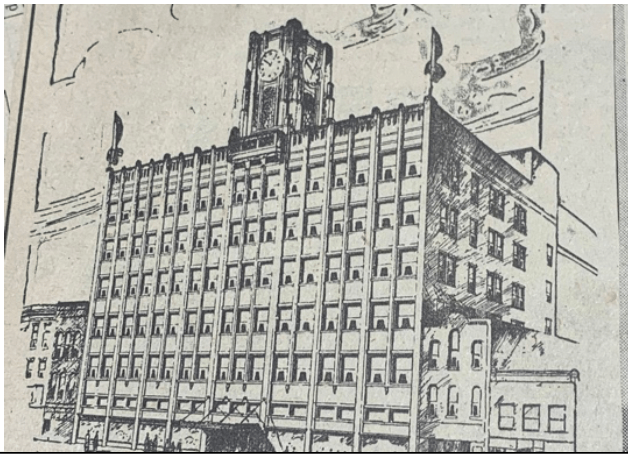
Erie, like most urban areas at this time of year, is bustling with holiday shoppers. But, over a century ago and for decades to follow, the most popular place to shop, which still holds fond memories for many residents, was the Boston Store in downtown Erie. Parents, grandparents, and just about everyone in Erie knew the meaning of “meet me under the clock.” The giant timepiece, located in the center of the main floor, was a familiar meeting place for shoppers rushing up and down the escalators. To understand why this iconic store was so fondly remembered by so many people, let’s first look at the history behind such a well- respected store in downtown Erie under the original name of Sibly’s. It was owned by a Rochester firm with a group of stores locals referred to as Boston Stores. A year later, the Erie location adopted that familiar name too. By the turn of the century, the store was expanding and eventually filled a complete block from State Street to Peach Street. In 1929 a redesign was planned by local architects, Myers and Krider. This new, modern design began as three stories but quickly grew to six which included plans for a pool on the top floor. However, due to accessibility issues, that idea was scrapped. More upgrades occurred with the installation of escalators and a water sprinkler system, the first commercial operation to do so in Erie, keeping the Boston Store updated and even more popular for its attention to customer service.

Throughout its history, The Boston Store made a memorable impression on its customers, as one resident describes, “What nice memories I have of the early ’50s, meeting in the downstairs cafeteria or under the clock.” For children, the Boston Store was a magical place as this former customer recalls, “I have wonderful childhood memories of special shopping days with my mother at the Boston Store including Easter dresses, school shoes, and our Christmas visit with Santa in the Fabulous Toyland.” It was also a hot spot for teens according to this former patron, “Next to the escalator you could pick up the Top 40 list from WJET radio. Occasionally they would have special lists such as the Top 500 songs of all time. I still have one copy of that from the 1960s.” It was a special place for employees too. Mercyhurst graduate, Barbara Chambers fondly recounts her days behind the counter. “Working on the main floor, near the elevators, in the Notions Department, gave me a view of almost every shopper who came to the Boston Store. As a result, I met lots of new people, customers, and passersby, as well as lots of my friends and relatives.” Ms. Chambers proudly explains that she earned 96 cents an hour and was required to follow the Boston Store’s modest dress code of “no sleeveless attire.” This may seem minimal pay and a bit strict
for today’s college students, but for the ’60s, when retail options were limited in Erie, a Boston Store clerk position was. highly valued by many young adults working their way through school.

By 1971 the Boston Store was quite familiar and most noted for marketing signs which wrapped around the building that covered a full block. They were also known for their mile marking signs making it clear just how many miles you were from one location to the front of the store. Some people even had similar signs placed in their yards. Due to the Highway Beautification Act, the five-foot, iconic signs were removed from state highways while some customers kept the signs as souvenirs. Erie, Historian Debi Lyon says, “The Boston Store mile marker signs used to be spread out all over Erie County, PA. It seems like they were posted along the roadside every few miles on Route 20, Route 8, and Route 5.”
For others, the memories reached far beyond clothing and jewelry. In the basement, the soda fountain was well known for its milkshakes and cafeteria-style lunches while the sixth-floor dining room was reserved for more special occasions.
By the early ’70s, shoppers were introduced to a new form of retail at local malls which took them out into the suburbs and away from downtown. In 1974, Erie’s new Millcreek Mall proved to be tough competition for the historic
Boston Store. However, there was still some hope left for the store to be remembered with a place in history. After the store closed its doors to retail business, The Villa Maria Academy decided to preserve the Boston Store as a historic landmark. But the effort failed and on July 7th, 1979, the Boston store closed its doors for good.
There have been some recent attempts to rebuild or recreate a new Boston Store but it’s nearly impossible to recreate the same experience that Erie residents carry only in their memory now. “I remember that the elevator attendant would announce the type of merchandise one could purchase on any given floor as the elevator doors opened. My fave announcement was Ladies Better Dresses.”
Today, there is a movement to return to downtown shopping and you’ll find Point Foure in the center of it all at its new location, 523 State Street. We don’t have Boston Store escalators, but we do have exceptional customer service, unique vintage clothing and we promise to give you a memorable shopping experience.
Special thanks to:

Ever wonder why we have a passion for red on Valentine’s Day? The red rose was the favorite flower of the Greek Goddess Venus

It might surprise you to know black is associated with Valentine’s too. In Korea, “Black Day” was created by singles who did not receive gifts. Singles celebrate by eating black noodles covered in bean paste.
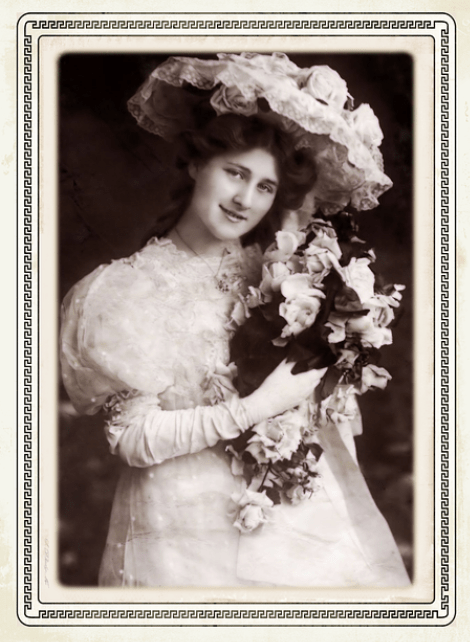
Today roses and chocolates are the signature gifts of Valentine’s Day. However, in the 18th century gentlemen gave a pair of gloves to their ladies of choice. If she chose to wear them it was a signal that she was indeed interested

The pandemic is ending. As we take off our masks and move back into dressing up, wearing makeup and styling our hair again don’t forget to get back into skin care routines too to reveal a new fresh face. History shows us some simple steps that still help us put our best face forward today.
Women in Ancient Rome wore face masks to cleanse their skin and often made them using natural ingredients such as olive oil, animal fat, rosewater, eggs, and almond oil. The oils were used as moisturizers to help with dry skin. They also developed the use of cold creams which contributes to some of the skincare techniques we currently use today.
The Egyptians also had interesting skincare techniques. For example, they would bath in cold water every day. They also used soap concoctions made of olive oil and clay. Milk and honey were used as a soothing face mask. The Egyptians took great care to cleanse the skin because they were obsessed with personal hygiene.

In Ancient India the use of Ayurveda was discovered. It’s a natural system of medicine, that is used to balance the body, mind and spirit. Throughout history, the Hindu have focused on anti-ageing and good health to maintain a youthful appearance. Ayurveda products and practices can be found in many spas today and means “knowledge of life.” Herbal ingredients, powders and oils have been part of the Hindu daily skincare routine for over 5,000 years.
In China people used bath beans made of native herbs, fragrance oils and soybean powder to freshen their skin. Pale white skin was prized and desired. To achieve the desired “brightness” the Chinese turned to lead, proving to be a deadly choice for many.
During the Middle Ages, long necks and high foreheads were considered a look of beauty. Women would often pluck their hairlines to make their forehead look longer. They used hog grease to moisten the skin and believed it could prevent the spread of diseases such as the plague.
By the 14th century white skin was a common beauty standard. Everyone wanted to make their skin look pale and bright. As a result, ladies used blaunchet, a type of ground wheat, to lighten their complexion. Sour milk was another option used to achieve this lighter complexion.
During the Victorian Era, more toxic chemicals were used to cleanse the skin. At the time, people did not know that these chemicals were toxic and likely did not know that these chemicals were actually the cause of many deaths. Some of the chemicals used were ammonia and mercury lead which both can cause a lot of damage to the body.
During The 20th century, regular skin care routines became more popular especially in America. New and branded products of moisturizers, soaps and masks began to be marketed to consumers. However, tan skin became the popular skin tone. Spray tans and powders made their way onto the market. Needless to say, everyone wanted to have a more golden glow.
During the 50’s the nuclear family became the goal to reach. Everyone wanted the perfect house with the white picket fence and women were expected to look their “feminine” best which included regular facial cleansing routines and shaving body hair. By the sixties, a healthy complexion was believed to be achieved through natural vitamins and supplements.
We have a worldwide history of caring for the largest organ on the body, our skin. Many methods we use today began generations ago. For example, we still use vitamins and suntan lotions. We also still use cleansing masks and creams to keep a youthful glow. However, we are more careful not to use dangerous ingredients such as lead making products of today safer, more regulated and more effective.
Even though skin care has changed throughout the centuries, we still strive to achieve a fresh, youthful look to our skin. After a year of covering up and hiding behind a mask, it’s time to put our freshest face forward. Share your skin care routine or favorite products in the comments below.

As we are hopefully nearing the end of the pandemic, the mask is happily becoming part of our past. However, the historical track of this face covering reaches far beyond medical purposes.

The earliest example of the mask is connected to rituals by people in Africa who used them to communicate with spirits. They were made of many different shapes and sizes and each African tribe had their own signature form. Inuit tribes in the Pacific Northeast made their mask out of leather, wood, and feathers with movable parts. These masks represented unity with humanity, their ancestors, and the beast they hunted. In Oceania, where they were big on ancestorial worship, they made strong big mask in honor of those who came before them. Ancient Aztecs in Laten America, used masks to cover up the dead. Initially they used leather, but later copper and gold were preferred. Ancient Greeks used their mask for theater during the renaissance period. Japan also used Kabuki masks for theatre as well.

Medical masks have a long history too. For example, during the 17th century plague, epidemic doctors wore bird-like masks to cover up. At the time, the disease was thought to be spread by bad odors in the air requiring doctors to be in full face cover ups with extended beaks to aide in breathing. During the flu epidemic of 1918, surgeons started wearing masks while operating on patients. Doctors also advised the public to wear masks as well to prevent further spread of the virus. A mandate that was not popular. People were dubious about the mask’s effectiveness. However, in Japan it was the opposite. They embraced the wearing of masks seeing it as an effective use of modern medical technology.
This scenario is similar to when the current pandemic first hit in America. Many were skeptical about the pandemic and about wearing mask. Others conformed in hopes it would keep themselves and others safe. Luckily, because of all our effort’s, things are starting to get back to normal. We can take off the masks and see smiles again.
Now that our masks are being removed, we can put a fresh face forward. Next time we’ll discuss the history of makeup.
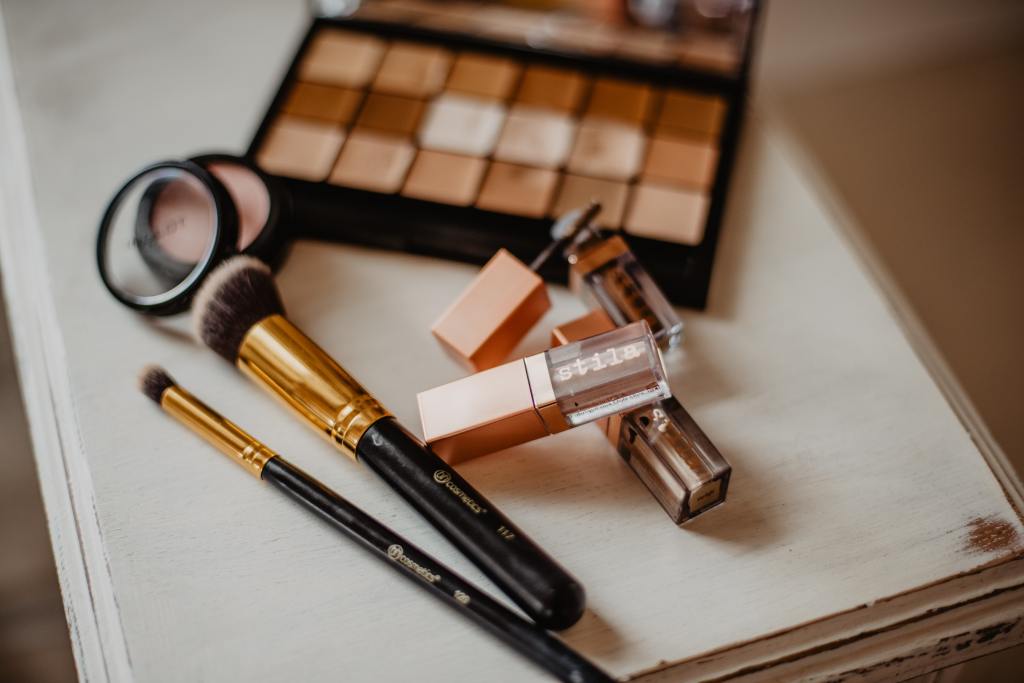
SOURCES:
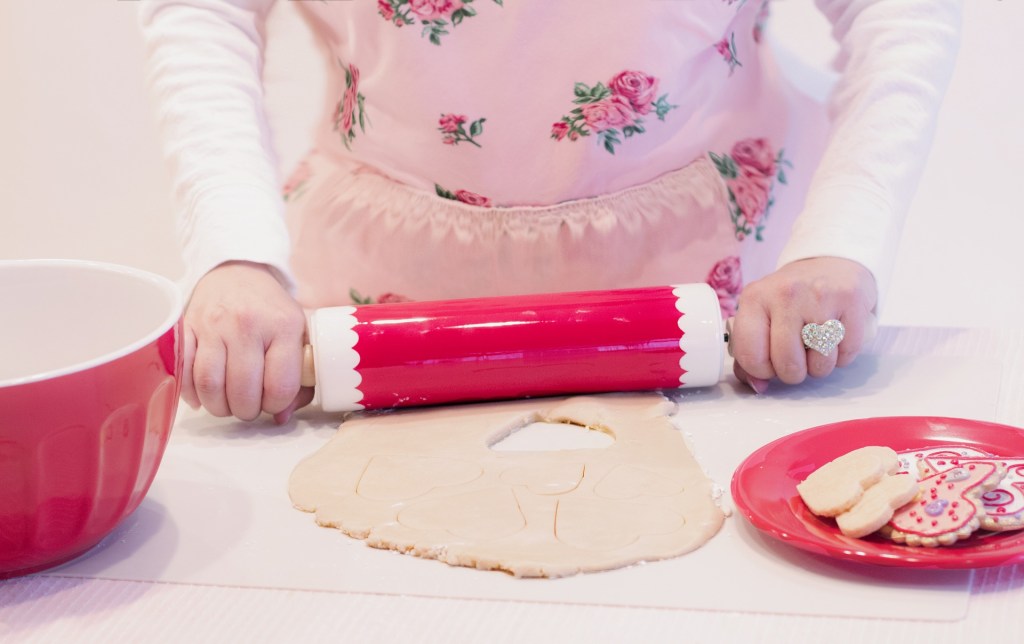
During the pandemic, you may have been forced to spend more time at home. Many of you have rediscovered simple at home activities like cooking. How does cooking relate to fashion? Well, the most essential fashion statement made for cooking is the apron. This iconic garment has a long history of use beyond the kitchen.

The word apron was originally derived from the French word ‘naperon,’ meaning small cloth and had no connection to today’s kitchen or cooking use. Used as a cover garment, it was originally intended as a loincloth. In ancient Crete, the apron is seen draped around figures of the Fertility Goddess, while in ancient Egypt the Pharaohs often had their aprons incrusted with jewels.
During the middle-ages aprons became more utilitarian and were worn by common workers and tradesmen. Cobblers wore black aprons as to not stain their clothes while working on shoes. However, some noble lads wore fancy aprons with their gowns as well. By the 16th century aprons became a fashion statement and have gone up and down in popularity ever since. Even Natives wore aprons for both practical and ceremonial reasons while pilgrims wore aprons as a symbol of hospitality.

During the 1940s and through the war years, families were commonly separated. After WWII, homecooked meals and being together were more appreciated and the apron became the symbol of the suburban housewife. People were prioritizing family and staying at home much like we have experienced during the pandemic.
Over time Men’s aprons were made for grilling while women’s aprons were made for cooking and baking. By 1960s the image of the housewife became less favorable, and women wanted more opportunities beyond the kitchen. So, aprons went out of style.
During the pandemic, people were spending more time at home, and cooking their own meals once again. The apron has made a big comeback with many styles for women and men.


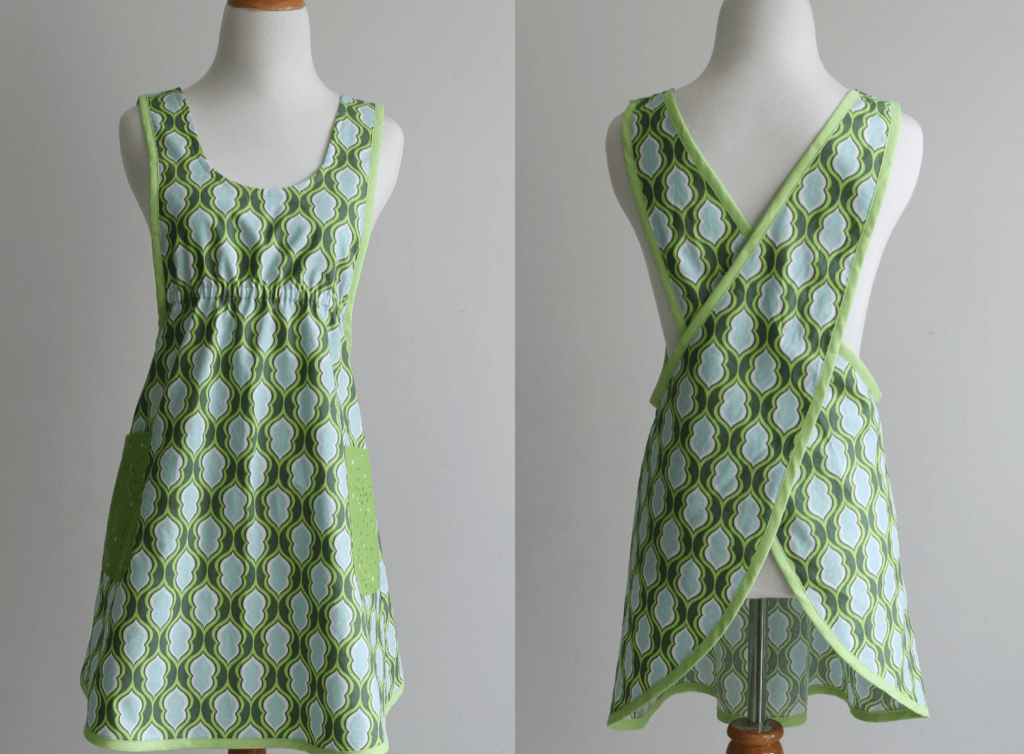

Half apron: small piece of fabric that extends from the waist to mid thigh
Bib apron: apron that covers the chest and ties around to neck
Cross back apron: aprons that feature straps crossing in the back
Pinafore: includes extra over the shoulder decorations such as ruffles or ribbons
As I researched this topic, I found many people have emotional memories connected to aprons. Whether it was the first garment they learned to sew or memories of grandmothers in aprons baking cookies and cakes, the apron has a place in history and in our hearts.
Do you wear an apron? Do you have an apron memory? Tell us your apron stories or show us your new or vintage aprons in the comments below.
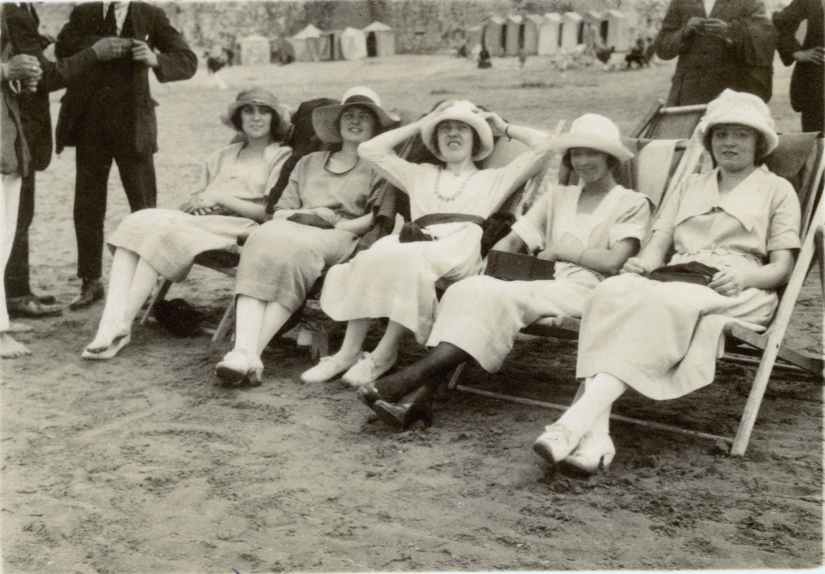
Enjoyed the summer with all of you. I am settling back into my second year at Mercyhurst so taking a little break to regroup. I’ll be back with more fashion history soon. Thanks for your interest and support.

Usually, I write my blog on an article of clothing and talk about its history. Today however, I’m taking a break from my usual format to share with you my visit to the historic Biltmore Estate in North Carolina, which actually does have an interesting historical fashion angle as well as a family connection for me.
Near the turn of the last century, the Vanderbilt family hired the worlds most skilled architects to build a luxury mansion in North Carolina.


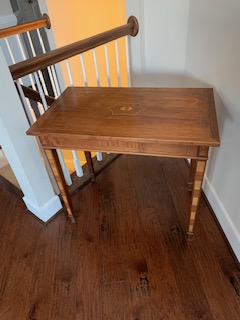
We decided to visit because my ancestor, Joseph Worrall, is said to have been one of the many carpenters hired to build this magnificent home. It is said, through family stories, that Joseph worked on the spiral staircase located in the library, which was George Vanderbilt’s favorite room. We also learned, through family stories, that Joseph made chairs and tables for the workers to rest and eat lunch during the construction years. One of those chairs sits in the corner of our home today along with a few other pieces of his master carpentry.
Before we visited the actual mansion, we had the opportunity to view a special exhibit featured at the estate based on the hit TV show Downton Abbey. The TV series chronicles the lives and struggles of the wealthy Crawley Family and their house servants during the 1800’s and would perhaps resemble the Vanderbilt’s as well. This exhibit showed the stark contrast between the family, the servants, women and minorities during this time in history.
The focus of the exhibit was the lifestyle and history of the era which cannot overlook the fashions of the day. For fans of the show, you might recognize some of the memorable garments worn by the characters which were part of this exhibit. For me, it was a detailed look at the fashion of the day. These garments were on loan from the show, but true to the era, similar styles could have been worn by the Vanderbilt’s and their guests as well.

The exhibit began with fashions for the lady of the house. This first outfit has a blue Sunday hat, paired with a blue, embroidered, floor length dress. It was worn by Violet Crawly, who was the Matriarch of the house in the series.
In contrast, another section of the exhibit was dedicated to the servant’s required uniforms. The Head Maid and Butler were in charge of everyone and dressed accordingly. The head maid of this household has a white button-down shirt paired with a floor length skirt. To finish off the look, there was a long black overcoat with a watch in the pocket in order to check the time and make sure the other servants were where they needed to be.
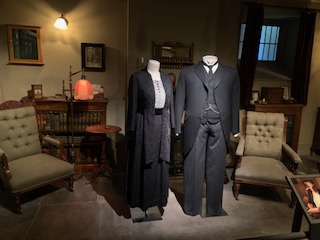
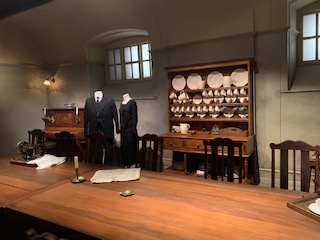
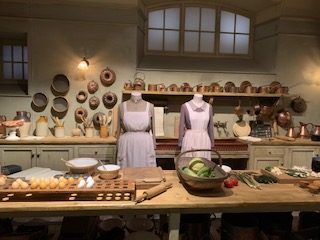
The Head Butler required a white button-down shirt with a black overcoat, black pants and a tie. He also had a watch, as promptness was expected at all times. The other servants such as the cooks and kitchen help wore simple floor length dresses with aprons tied around them because the work was fast and dirty.

Other servants were required to answer the bell board, which was kind of like a telephone room where the bells would let each servant know which room they were needed in and who was requesting a service. The female servants wore long, blue, floor length dresses with a belt around the waist and buttons on the top. The men would wear the traditional butler suit and a tie, but without the watch.
The highlight of the Downton Abbey exhibit was of course the evening dresses. During this time period, dresses had a more boyish figure to them in order to stray away from the restricting and repressive corset. This, as a result, made the older generation despise the younger generations choice in fashion. Here are a few of the dresses that we saw at the exhibit.

One of the dresses that caught my eye was a teal, long, floor length, strapless dress with white gloves. It had a matching waist band with sparkling embroidery on the top. Next was a crimson red, maxi length dress with pointy toed black shoes to match as well as black gloves. The third gown is a blue, long sleeve, maxi length dress and matching blue shoes. The accessories were a silver tiara, a silver necklace and pure white gloves. The head to toe detail of each gown with its beading and delicate fabrics shows the effort place on formal wear during that era.
We ended our visit with a tour through the actual Biltmore home. There were many rooms with amazing features but I’m sharing a few of my favorites.
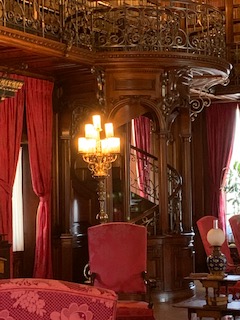
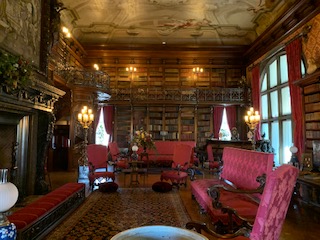
First, of course is the library which was Mr. Vanderbilt’s favorite room as well. He loved to read and had books of many languages in his collection. The staircase that my great-great- great- grandfather we believe may have had a hand in making is located there as well. It is delicately carved and leads up to the second level of the library. We just gazed at the beauty of this amazing woodwork.
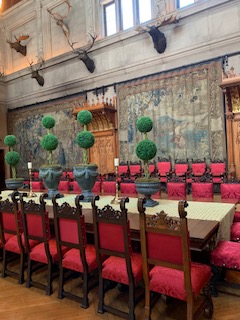
Another favorite room of mine was the dining room where the family and their guests held formal events. I could imagine them dressed in formal gowns, gloves and jewelry for dinners that would last 2-3 hours. The dinners were less about eating and more about socializing. There were often 6 courses to their meal and the dinners were all about entertaining their guests.

The next room we entered was Mr. Vanderbilt’s bedroom. The bed appeared to be small but only because it was set inside one of the biggest rooms in the home.
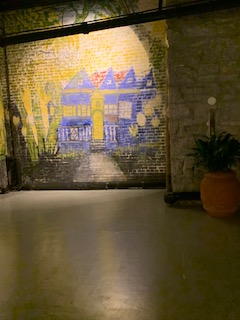
The tour ended in the Halloween room. This basement space was originally a storage room, but one night, when the Vanderbilt’s hosted a New Year’s Eve party, they invited the guests to paint the walls. They painted bats, spooky houses, and flowers but none of them were based on Halloween. In fact, they were based on songs from a popular German play of the time period. It was one of my favorite rooms.


I can understand why the history of the Biltmore is well studied. For me, the trip combined my two favorite subjects of history and fashion with a bonus family connection that made it even more interesting. I’m so glad I got to see it for myself.
 fashionpastforward.com